
Helen Martins

Helen Elizabeth Martins was a private and reserved individual who rarely appeared in public in Nieu-Bethesda. Beneath this quiet exterior, however, she nurtured a rich inner world that she later expressed through the creation of the Owl House. Born in Nieu-Bethesda on 23 December 1897, Helen was the youngest of six children. She completed her schooling in Graaff-Reinet, qualified as a teacher, and later married Johannes Pienaar, a teacher and dramatist. The marriage was unhappy, and after travelling briefly, Helen returned to Nieu-Bethesda in 1928 to care for her ailing parents. Her mother died in 1941 and her father in 1945. Their relationship was strained, and Helen eventually moved her father into a separate room, later known as the Lion’s Den, which she painted black.

A Young Helen Martins
After her parents’ deaths, Helen began transforming her home as an expression of her search for light, beauty, and meaning. Her intense dedication to this work took a toll on her health and contributed to her increasing withdrawal from public life. At the age of 78, suffering from severe arthritis and progressive vision loss—possibly caused by working with ground glass—she took her own life by ingesting a caustic soda mixture. She died three days later, on 8 August 1976, in a hospital in Graaff-Reinet. Her fear of being separated from the Owl House was profound, and her legacy continues to inspire visitors to this day.

Helen Martins in Her Later Years
Koos Malgas
To realise her vision, Helen Martins employed local craftsmen. Jonas Adams and later Piet van der Merwe assisted with structural alterations to the house, including replacing original windows with large panes of coloured glass to flood the interior with light. Van der Merwe also helped bring Helen’s outdoor ideas to life; one of his early cement owls remains in the Camel Yard.
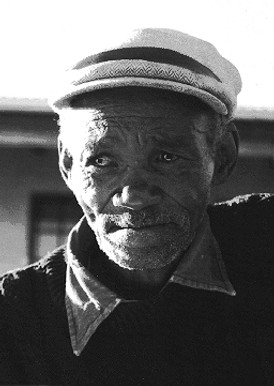
An Older Koos Malgas
Around this time, Helen engaged Koos Malgas, an itinerant sheepshearer and builder. Koos quickly developed skill in working with cement and glass and proved adept at interpreting Helen’s concepts. Their collaboration became highly symbiotic: each sculpture was discussed in advance, often over early morning coffee, and although Helen rarely undertook physical labour herself, she and Koos jointly engineered each creation. His contribution was integral to the development of the Owl House.
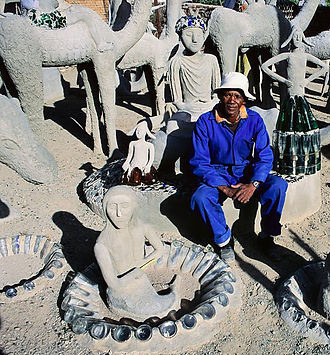
Koos Malgas worked with Helen Martins on the Camel Yard for twelve years, until her death in 1976. He remained in the area for two additional years before relocating to Worcester. In 1991, he returned to Nieu-Bethesda to assist with restoration work at the Owl House, where he remained until his retirement in 1996. Koos Malgas died in Graaff-Reinet on 20 November 2000, in his early sixties.

Koos Malgas in the Camel Yard
The Owl House: Helen Martins and Koos Malgas
The Legacy of Creativity and Collaboration in Nieu-Bethesda
Helen Martins: The Visionary Behind the Owl House
Early Life and Education
Helen Elizabeth Martins was born in Nieu-Bethesda on December 23, 1897, as the youngest of six children in the Martins family. Her childhood was shaped by the rural isolation of the Karoo, and despite her reserved nature, Helen maintained a deep and imaginative inner world. She completed her schooling in Graaff-Reinet, a nearby town, where she qualified as a teacher. Helen’s dedication to education and the arts led her to marry Johannes Pienaar, a fellow teacher and dramatist. However, their marriage proved to be unhappy, and after a period of travel, Helen returned to her hometown in 1928 to care for her aging parents.
Family Struggles and the Lion's Den
Helen’s relationship with her parents, particularly her father, was strained. As she cared for them through their final years, the emotional tension in their household grew. After her mother’s death in 1941 and her father’s passing in 1945, Helen made a symbolic gesture by moving her father into a separate room—later named the Lion’s Den—which she painted black. This act marked both her need for personal space and her desire to redefine her surroundings, foreshadowing the creative transformation that would later unfold in her own home.

Transformation of the Owl House
After her parents’ deaths, Helen Martins embarked on a radical transformation of her home, which came to be known as the Owl House. Driven by a longing for light, beauty, and meaning, Helen sought to escape the darkness that had settled around her. She replaced the original windows with large panes of colored glass, flooding the interior with vibrant light and casting rainbow hues across the rooms. Helen’s intense dedication to this project became both her solace and her obsession, as she poured her energy into creating a sanctuary filled with sculptures, mosaics, and fantastical designs.
”
“
Ah Moon of my Delight
How oft here – after rising
Shall she look.
Through this same Garden
After me – in vain.
Health Decline and Final Years
As the years passed, Helen’s relentless pursuit of her artistic vision isolated her further from the outside world, yet her creativity flourished within the sanctuary she had built. Surrounded by a growing collection of glass, wire, and cement figures—owls, camels, and wise men—Helen’s home became a unique reflection of her inner life, symbolizing both her yearning for transcendence and her resilience in the face of personal hardship. Visitors today are drawn not only to the enchanting atmosphere of the Owl House but also to the story of its creator’s courage and imagination, which continue to resonate through the spaces she so lovingly transformed.

Helen Martins in Her Later Years
While Helen’s artistic journey was deeply personal, it was also shaped by the collaborative spirit she fostered with local craftsmen, particularly Koos Malgas. Their partnership, founded on mutual respect and creative synergy, allowed Helen’s imaginative visions to take tangible form in the gardens and yards surrounding the Owl House. Together, they sculpted an extraordinary landscape of mythical creatures and symbolic figures, blending cement, glass, and ingenuity to craft a world unlike any other. This legacy of collaboration not only enriched Helen’s work but also ensured that the Owl House remains a testament to the transformative power of shared creativity and the enduring impact of community in the heart of Nieu-Bethesda.

Helen Martins,
The Enigma Of Nieu Bethesda
The legacy of Helen Martins and Koos Malgas endures not only in the physical artistry of the Owl House but also in the inspiration they ignite within those who visit and study their work. Today, the site stands as a vibrant monument to the triumph of imagination over adversity, inviting people from all walks of life to reflect on the ways creativity can transform spaces and selves. Their story remains a poignant reminder that collaboration and vision can leave a profound mark on a community, shaping its identity and offering hope for generations to come.
As scholars, artists, and travelers explore the Owl House, they find themselves immersed in an environment where every detail echoes Helen’s pursuit of meaning and Koos’s craftsmanship. The ongoing preservation efforts highlight the importance of protecting such unique cultural treasures, enabling visitors to witness firsthand the extraordinary results of creative vision and collaboration. This living museum not only honors the memory of its makers but also encourages all who enter to embrace curiosity and imaginative expression, ensuring that the spirit of the Owl House continues to inspire new generations.

Declared a National Heritage Site in 2017
In the years since Helen Martins and Koos Malgas left their indelible mark on Nieu-Bethesda, the Owl House has evolved into a place of pilgrimage for those seeking the intersection of art, history, and personal storytelling. The unique interplay of light, color, and sculptural forms invites visitors to experience the environment not just as a static exhibit, but as a dynamic expression of the human impulse to create and find meaning. As each new guest explores the labyrinth of wonders, the story of Helen and Koos grows, reminding us that even in isolation, innovation and collaboration can flourish, leaving a legacy that transcends individual lives and speaks to the universal desire for connection and beauty.

As the Owl House welcomes ever more visitors, its significance as a beacon of creative resilience is continually reaffirmed. The interplay of artistic vision and communal effort found within its walls and gardens serves as a touchstone for those inspired by unconventional paths and the transformative potential of imagination. In preserving Helen Martins’s and Koos Malgas’s extraordinary achievements, the community of Nieu-Bethesda and the Owl House Foundation, not only honors its heritage but also fosters an ongoing dialogue about the value of art, collaboration, and the courage to shape the world anew, ensuring that the Owl House’s story will endure for generations yet to come.
Looking to the future, the Owl House remains not only an iconic testament to the lives and collaboration of Helen Martins and Koos Malgas, but also a vibrant catalyst for artistic exploration and community connection. As new generations of visitors and creators draw inspiration from its whimsical sculptures and radiant colors, the site continues to foster dialogue around the transformative power of creativity. The ongoing stewardship by locals and preservationists ensures that the Owl House’s spirit thrives, inviting each visitor to contemplate their own capacity for imaginative expression and the enduring impact of shared vision within a community.

The Crafters Outside the Owl House
The crafters outside the Owl House are more than vendors—they are custodians of a living tradition. Their work extends Helen Martins’ and Koos Malgas’s legacy by ensuring that the Owl House remains a place where art is continually made, shared, and reimagined, keeping Nieu-Bethesda’s outsider art spirit alive.
Their works are often inspired by the motifs of the Owl House—owls, suns, camels, and fantastical figures—but they also incorporate contemporary Karoo identity and personal creativity. The presence of these crafters transforms the Owl House from a static heritage site into a dynamic cultural hub, where visitors engage not only with Martin's and Malgas’s legacy but also with living artists.
This matters as the crafters benefit economically from the steady stream of visitors, making the Owl House a source of local sustainability. By echoing Malgas’s role as a maker, they keep alive the collaborative spirit that defined the Owl House. Visitors leave not only with memories of Martins’ and Malgas’s sculptures but also with tangible pieces of living Karoo creativity.

